Safety problem
Recognize risky motion, not only pedestrian presence.
Lingering, squatting, and other unexpected behaviors near tracks require a system that understands motion patterns and can localize the person at risk.
04 / Computer vision · Public-safety AI
A real-time deep-learning platform that learns normal pedestrian motion from skeleton trajectories and detects risky behaviors at railroad grade crossings.
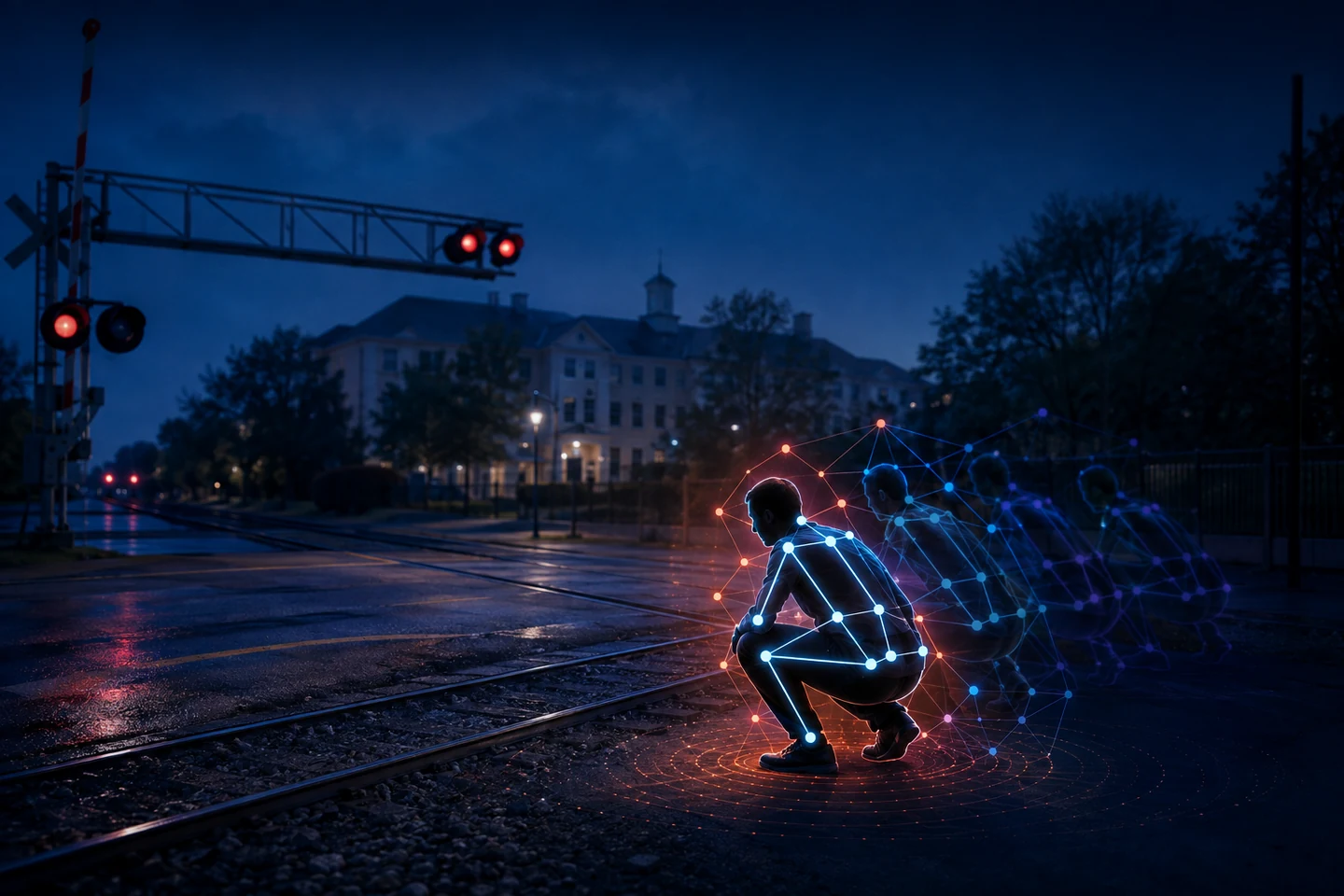
Safety problem
Lingering, squatting, and other unexpected behaviors near tracks require a system that understands motion patterns and can localize the person at risk.
Learning strategy
OpenPose converts pedestrian behavior into skeleton-coordinate sequences. STGCN-PAD learns their normal spatiotemporal structure and uses reconstruction error to detect unfamiliar motion.
Field demonstration / 01
Camera input, skeleton extraction, motion assessment, and visual/audio alerts in railroad grade-crossing environments.
Performance / 02
The MLP-Mixer reconstruction option substantially reduces inference time while preserving comparable anomaly-detection performance.
Pipeline / 03
Represent each pedestrian as a sequence of skeleton keypoints rather than raw appearance.
Model joint relationships within each frame and across consecutive frames using ST-GCN layers.
Reconstruct normal trajectories through a CNN or faster MLP-Mixer network.
Detect unfamiliar motion from reconstruction error and localize the corresponding pedestrian.
Research role / 04
Methodology, formal analysis, and original manuscript; co-contributor to the study concept and investigation.
Publications / 05
Three journal articles document the progression from skeleton-trajectory detection and localization to semi-supervised learning and spatial-temporal graph modeling.