Challenge
Large-scale 3D characterization and simulation are expensive.
Detailed electrode microstructures are costly to acquire, while resolving physics throughout a large domain can require substantial computational effort.
01 / Ongoing research · Battery materials
Developing data-efficient, physics-aware methods that reuse local microstructure knowledge to support scalable analysis of larger three-dimensional electrode domains.
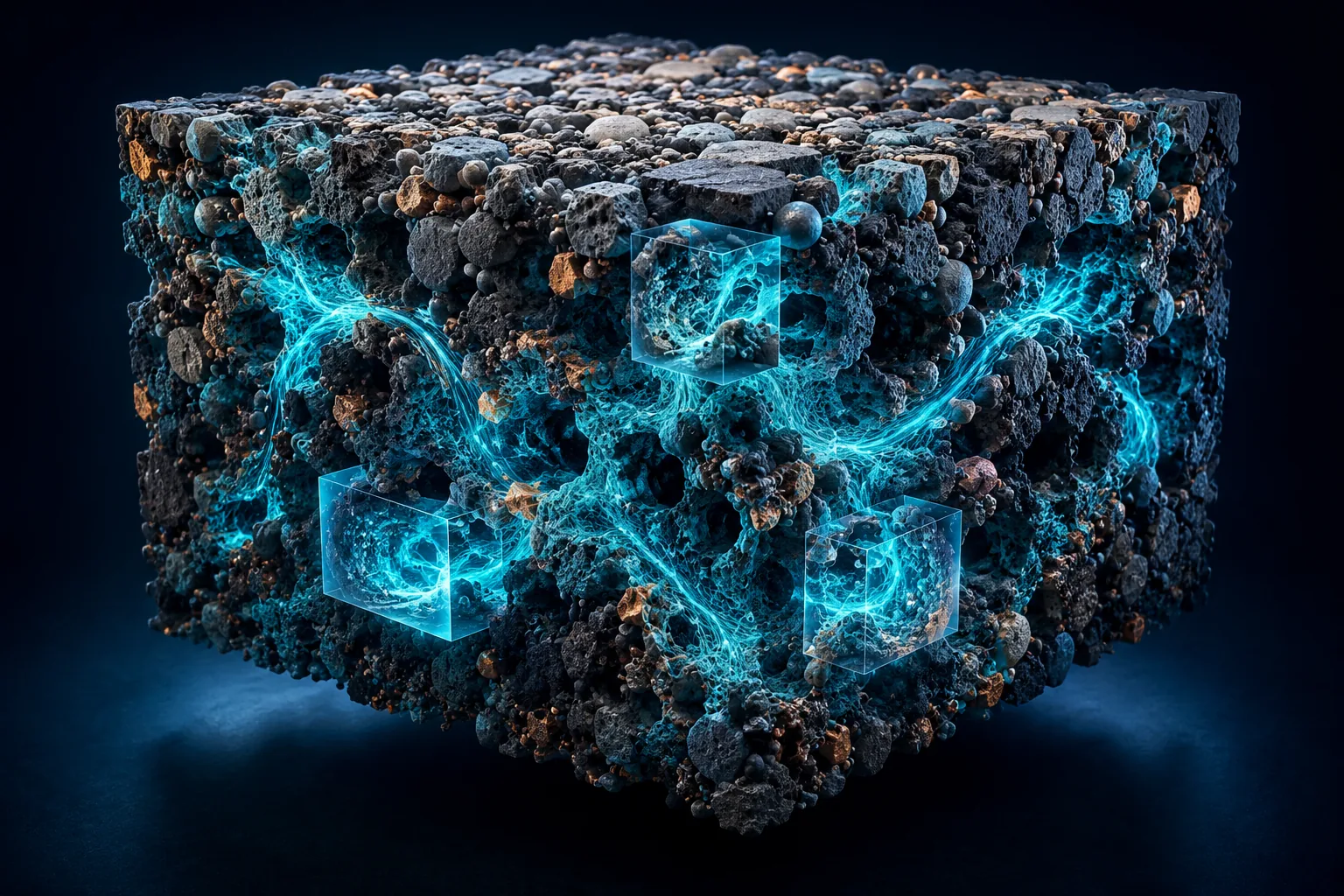
Challenge
Detailed electrode microstructures are costly to acquire, while resolving physics throughout a large domain can require substantial computational effort.
Research goal
The project explores how learned microstructure–physics relationships and limited high-fidelity observations can support efficient, physically meaningful large-domain analysis.
Public research scope / 01
Learn reusable relationships between electrode morphology and physical behavior at manageable scales.
Use a limited amount of high-fidelity information where it provides the greatest value.
Transfer local understanding toward larger and more complex electrode domains.
Prioritize continuity and credible physics rather than visual realism alone.
Intended value / 02
Carry learned local structure–physics knowledge into new analysis tasks.
Reserve costly characterization and simulation for the most informative regions.
Support efficient investigation of electrode domains beyond fully resolved small volumes.
Current stage / 03
Status
This page intentionally presents only the project motivation, broad direction, and intended engineering value.
Publication boundary
The model architecture, information-selection strategy, computational workflow, experimental design, and results are withheld while the work is under development.