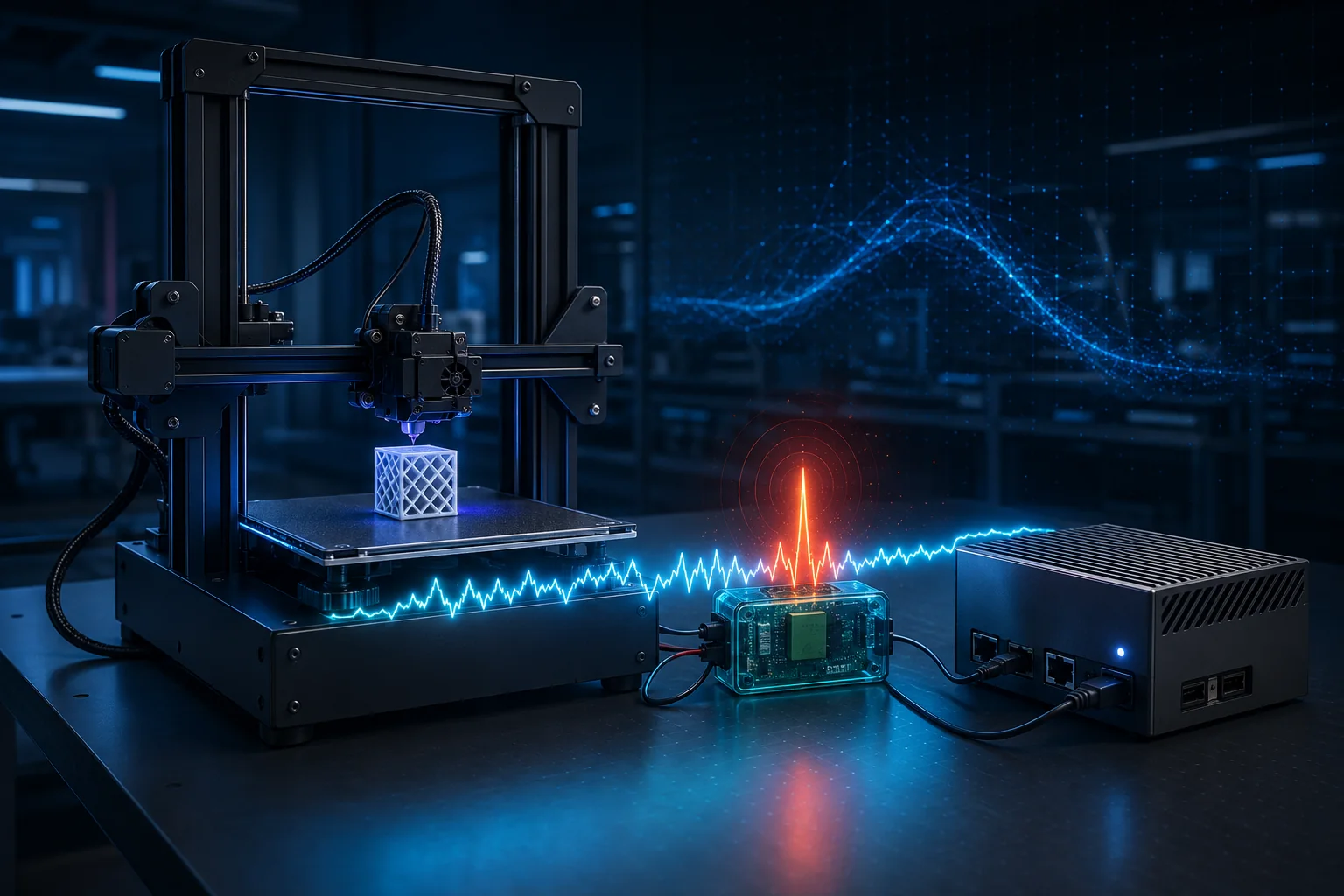
A side-channel energy-auditing framework for detecting operational anomalies and cyber-physical risks in robotic and additive-manufacturing processes.
Edge Computing
Energy Auditing
Anomaly Detection
3D Printing
Side-channel energy auditingReal-time edge intelligence
Safety and security problem
Monitor equipment without trusting its internal network.
Networked manufacturing systems can experience process drift, equipment faults, or malicious manipulation. Internal logs alone may be compromised or may not expose subtle physical changes.
Side-channel strategy
Read the machine through its energy signature.
An independent energy meter captures power-consumption patterns while semi-supervised models learn normal operation and flag deviations near the machine in real time.
Research presentation / 01
From side-channel sensing to an edge alert
This presentation introduces the 3D-printing testbed, anomalous process settings, learnable positional embedding, and both offline and online validation.
Web-optimized presentation · 2 min 36 sec · 3D printer, energy meter, transformer model, and Jetson edge deployment
System / 02
Independent sensing with edge intelligence
01
Side-channel sensing
A PZEM-004T energy meter records the 3D printer's electrical behavior outside the printer-control network.
02
Minimal coordination
A Raspberry Pi running OctoPrint and ROS sends only a process-start trigger; monitoring then proceeds independently.
03
Real-time edge inference
A Jetson AGX Orin reconstructs normal energy patterns and raises an alert when reconstruction error exceeds the learned threshold.
Validated performance / 03
Sensitive to process changes that shorten or distort a print
The learnable positional embedding captures both local energy patterns and global process duration, allowing the model to detect early terminations that benchmark methods missed.
~98%
Detection accuracy for early termination cases
~88%
Recall across speed and thickness cases
+5 mm/s
Detectable printing-speed variation in sensitivity tests
+0.02 mm
Detectable layer-thickness variation in sensitivity tests
Applications / 04
One monitoring principle across manufacturing systems
The research advances from robotic-manipulator auditing to real-time monitoring of additive-manufacturing equipment.
Robot operation
Manipulator health and security
GAN and U-TFF models learn normal energy behavior and detect deviations associated with operational anomalies and physical attacks.
Additive manufacturing
In-situ 3D-printing monitoring
A transformer with learnable positional embedding detects changes in bed temperature, printing speed, layer thickness, and process duration.
Method progression / 05
Three generations of energy-auditing models
2023
GAN reconstruction
Use normal robotic-manipulator energy traces to train a generative adversarial anomaly detector.
2024
U-TFF
Fuse time- and frequency-domain features through a U-Net architecture for stronger manipulator monitoring.
2025
Learnable position
Encode time instants and sliding-window positions so one transformer can detect local and duration-based 3D-print anomalies.